
Worksheet: Meet Your Shadow
Have you ever done something and then wondered, “Who was that? That wasn’t me”?
Maybe it was a relapse. A hurtful comment you didn’t mean to say. Or that familiar feeling of sabotaging yourself right when things were finally going well. The uncomfortable truth? It was you—just a part of you that’s been hiding in the shadows.
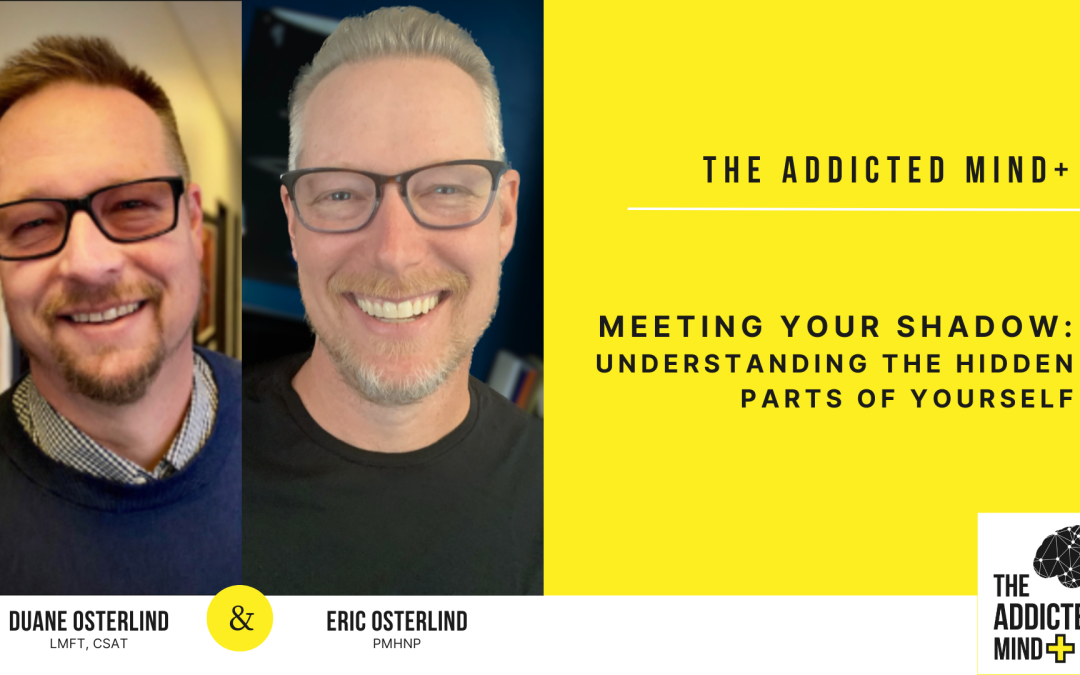
In this episode of The Addicted Mind, Duane and Eric Osterlind explore one of psychology’s most powerful concepts: the shadow self. First named by psychiatrist Carl Jung, the shadow is the unconscious part of your personality where you’ve stuffed everything you think is unacceptable—your anger, jealousy, selfishness, and those desires you don’t want anyone to see.
Here’s the problem: what you repress grows in the dark.
The more you ignore these hidden parts of yourself, the stronger they become. And for those struggling with addiction, the shadow often becomes the invisible force that hijacks your recovery and drives you back into old patterns. It’s exhausting trying to be “good” all the time while fighting a war inside yourself.
But here’s the twist that might surprise you: your shadow isn’t just the “bad” parts. It also contains buried treasures—your creativity, your passion, your drive. These gifts often get locked away because they seemed “too much” or not acceptable to the people around you.
The goal of shadow work isn’t to destroy these parts of yourself. It’s not about fixing something that’s broken. As Duane and Eric discuss, drawing from Internal Family Systems therapy, there are no bad parts. Every part of you is trying to help in some way, even if that help has become distorted over time.
Instead, shadow work is about integration—bringing these hidden parts into the light so you can understand them and find healthy outlets for their energy. When you stop running from your shadow, something amazing happens: you free up all the energy you were using to keep that basement door locked. That energy becomes available for your recovery, your relationships, and your life.
In this episode, you’ll learn two practical ways to start exploring your shadow safely. First, pay attention to what annoys you in other people. That strong reaction? It’s often pointing to something you’ve disowned in yourself. Second, get curious about your negative traits instead of shaming them. That anger you hate? It might be protecting you. That laziness? It might be your body begging for rest.
The path to freedom isn’t about becoming perfect. It’s about becoming whole. A real person has a shadow—and meeting yours might be the most important step you take in your recovery.
Key Topics
- What is the shadow self? Carl Jung’s concept of the unconscious parts of our personality we’ve denied, rejected, or repressed
- Why whatever you repress grows in the dark—and how this fuels addiction and self-sabotage
- The shadow isn’t all bad—hidden within it are creativity, passion, and drive
- Integration vs. fixing—why there are “no bad parts” and what that means for recovery
- The projection exercise—how what annoys you in others reveals your own shadow
- Getting curious instead of shaming—finding the positive intention behind negative traits
- Wholeness over perfection—reclaiming the energy spent hiding from yourself
Timestamps
- [00:01:00] – Introduction: Have you ever felt like there’s another part of you living inside?
- [00:03:00] – The pain point: Self-sabotage and the exhaustion of trying to be good all the time
- [00:05:00] – Carl Jung’s shadow concept explained: The bag we drag behind us
- [00:06:00] – The twist: Your shadow contains hidden gifts, not just darkness
- [00:08:00] – Integration vs. fixing: Why there are no bad parts
- [00:09:00] – Action step #1: Exploring your projections—what annoys you in others
[00:11:00] – Action step #2: Getting curious about your negative traits
Follow and Review: We’d love it even more if you could drop a review or 5-star rating over on Apple Podcasts. Simply select “Ratings and Reviews” and “Write a Review” then a quick line with your favorite part of the episode. It only takes a second and it helps spread the word about the podcast.
Supporting Resources:
If you live in California and are looking for counseling or therapy please check out Novus Mindful Life Counseling and Recovery Center
We want to hear from you. Leave us a message or ask us a question: https://www.speakpipe.com/addictedmind